
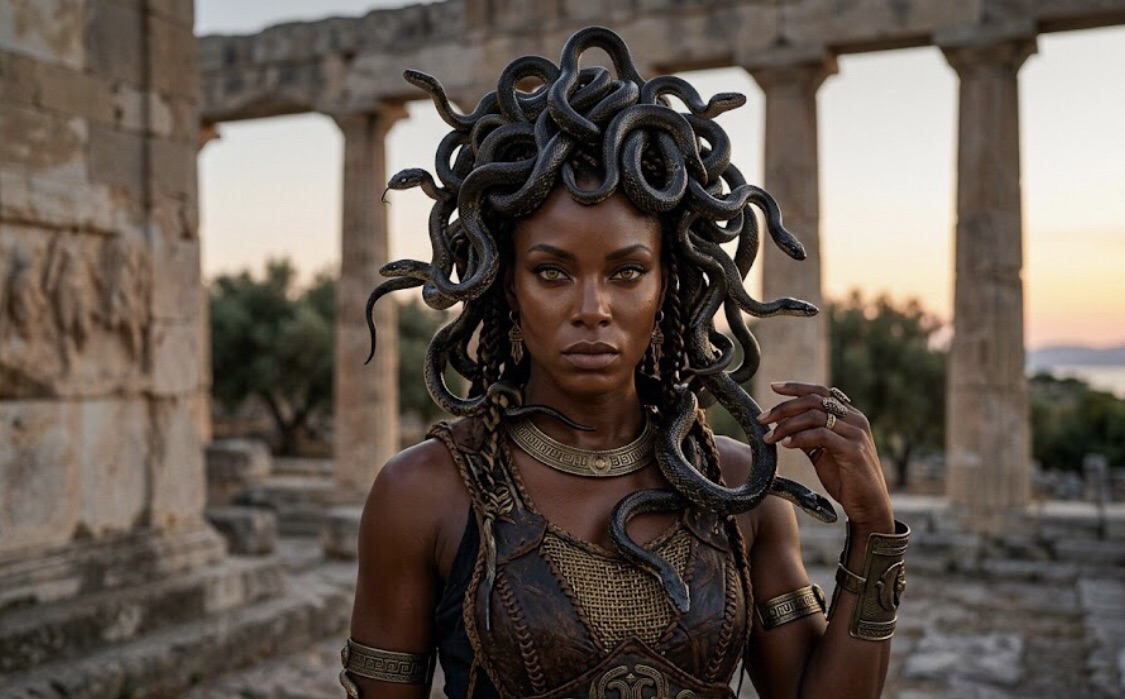

If you know the true story of Medusa, she was a victim of sexual assault, yet history has often portrayed her as a villain. Even though Medusa is a figure in Greek mythology, she appears in many ways to me as a Black woman of African descent. When I think of her hair of snakes, I see the coarse locks of a Black woman. When I think of the abuse Black women have endured at the hands of slave masters and, even today, at the hands of their own men, Medusa comes to represent the rage, pain, and resilience of women who have been violated and then vilified in their victimhood. She carries the energy of every woman who has been made into a villain for surviving what was done to her, but especially for me, she resonates as a symbol of Black womanhood.
She has been vilified, victim blamed, victim shamed, and banished. Her rage became a trauma response. Her rage was reactionary survival. Her rage was sacred and necessary for her protection.
I sat at the edge of my bed, and Medusa came to me, bringing clarity.
One. There are daughters whose mothers emotionally, physically, verbally, and psychologically abused them after those daughters were sexually abused or molested by their mother’s boyfriend or husband. In these cases, the daughter becomes a threat instead of a victim. She becomes competition instead of a child in need of protection and healing. The mother resents her daughter for what the boyfriend or husband did. She becomes bitter, jealous, and insecure instead of compassionate, supportive, and protective.
Two. These are often mothers who experienced similar trauma and received the same response from their own mothers. This is how generational cycles of sexual abuse and dysfunction are passed down. We learn how to respond to trauma from the people who raised us, even when those responses are unhealthy. It can become normalized to stay with someone who has harmed your child. It can become normalized to silence victims. It can become normalized to punish victims for what they survived. It can feel easier to protect the relationship than to face the truth of the harm.
Three. In many homes, it becomes easier to silence the child than to confront the adult who caused the harm. It becomes easier to groom survival than to heal betrayal.
Four. I am speaking to the inner child who felt trapped in a home filled with abusive patterns and had nowhere to run. I am speaking to the inner child who was forced into silence well into adulthood, especially the rebellious teenager who fought to reclaim a voice that was never nurtured. Your rebellion may have been messy. It may have been painful or misunderstood, but it was an attempt to reclaim an innocence that was taken while you were blamed for losing it.
Five. I am speaking to the inner child of a woman choosing to heal generations of abuse while restoring honor to her own legacy. I am speaking to the inner child who had to sit with her wounds alone in a wilderness that was supposed to feel like home.
And like Medusa, your rage was never the problem. It was the result of betrayal, silence, and survival. She was turned into a monster so others would not have to face their guilt. You were judged in the same way. But Medusa was never evil. She was transformed by pain, strengthened by survival, and forced to protect herself when no one else would.
Your healing is the moment Medusa is finally seen not as a villain, but as a woman who survived. You are not your mother. You are not your trauma. You are a survivor. Your rage is sacred.

